RSS

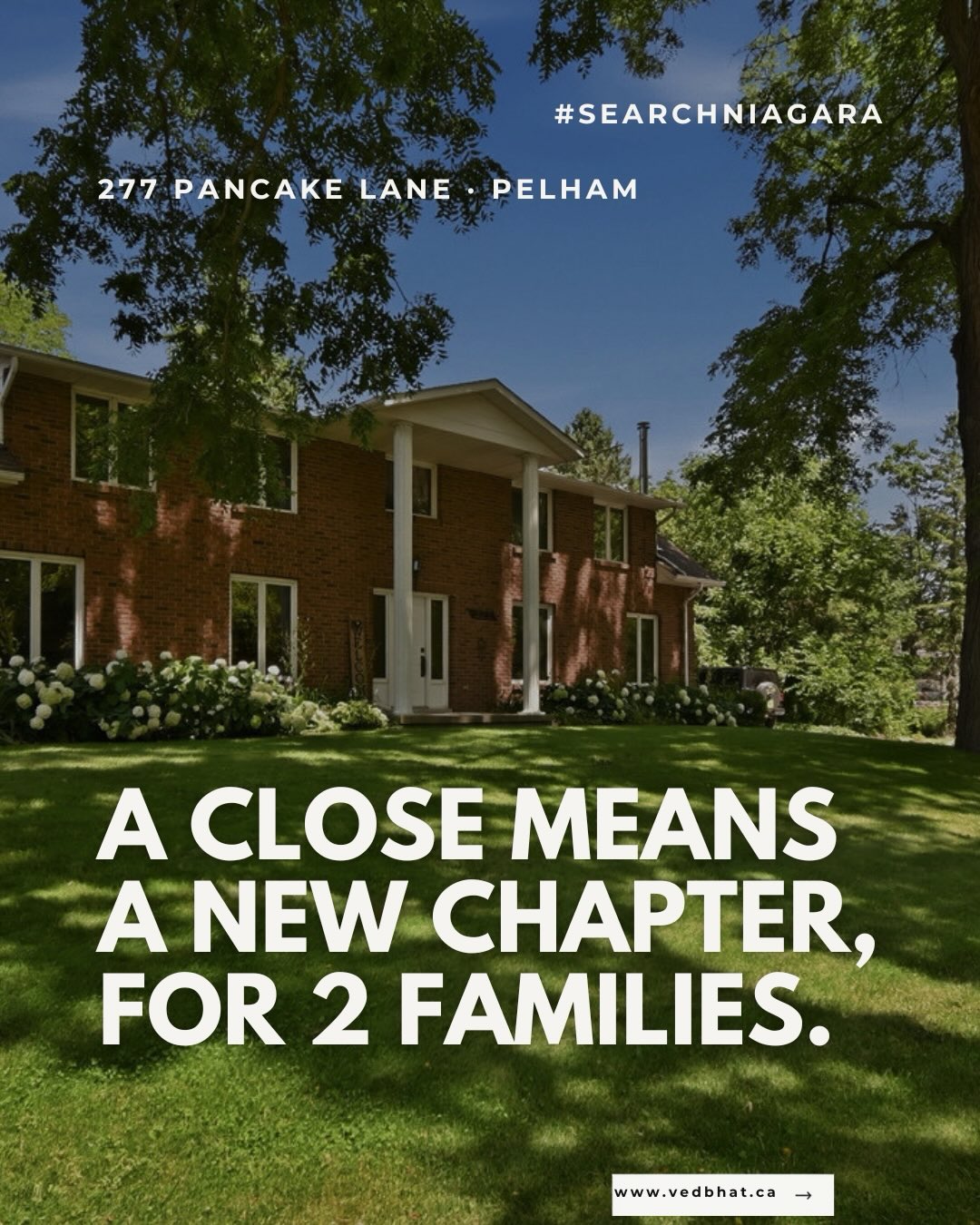
A Close Means a New Chapter for Two Families

277 Pancake Lane, Pelham. A close means a new chapter for two families.

277 Pancake Lane, Pelham: a close means a new chapter for two families

I am immensely grateful for this experience.

It starts with my clients: for trusting me with their business, for talking strategy with me, and for coming to an agreement that got us the outcome we wanted, within the timeline we expected.

Like most real estate transactions, this one would not have been possible without the entire team working together. That includes my media crew, my stager, my cleaning crew, the lawyer and everyone else. Just as important are my industry colleagues, and the agent who represented the buyers, who helped make this transaction smooth and a good experience for everyone involved.

This sale also let me show what I bring to my service from start to finish. As I often mention, I come from a corporate and marketing management career, and I bring those strengths into real estate: being organized, communicating, having a marketing strategy in place, tracking the data, and keeping my clients informed on how everything is going, with the numbers that matter and what they mean.

14 days from listed to sold conditionally.

  • 4,871 REALTOR.ca views.

  • 2,550 vedbhat.ca page visits.

  • 1,992 Instagram views.

  • 4,600+ mailcards delivered.

  • 20+ doors knocked.

  • 10+ agents at the REALTOR® open house.

  • 15+ groups through the public open house.

  • 4 interested buyers from the signage and door knocking.

  • 25+ showings booked.

Behind the sale of this unique property: 12 pieces of marketing content and 2 events.

I look forward to many more. If you’re looking to sell, buy or lease, residential or commercial, I can let you know if what I do and how I work will work for you. Call me or DM me and let’s talk.

See the carousel: A close means a new chapter on Instagram

Read

NSC 2026: A National Conference in My Home Region

Almost two decades of corporate conferences before real estate. I thought I knew what to expect at NSC 2026. In some ways, I did.

Agents from across the country in one room, the keynotes, the polish, and $300K raised for the Royal LePage Shelter Foundation in a few days. That’s company-scale effort. But everyone in that room runs their own business.

Nobody was sent there, and nobody was told to give. I played in the Shelter pickleball, joined the East vs. West Shelter Classic and danced at the East Coast Kitchen Party, all for a cause everyone chose to show up for. And I wasn’t in a suit. I wore my hoodies because they’re what I’m comfortable in. One said “Not lost, I live here” on the front and “Brown bald realtor, say hi” on the back, which felt right for a national conference in my home region. People actually came up and said hi, and a few found it funny.

A fabulous experience. The food was excellent all the way through, I met so many people, made real connections, and I’m looking forward to staying in touch. On the business side, I now know a good REALTOR® in all 10 provinces. So I can help you here in Ontario, and if you or yours are moving to another province, I can make sure you have a contact there.

The night at the Power Station

Right in our backyard, so to speak, and my first visit.

What a fabulous venue by Niagara Parks. For the Royal LePage event, the old Niagara Parks Power Station became a club for the night. I loved the whole setup.

The station generated power from 1905 until 2006, and today it’s a museum and event venue. Taking the glass elevator 180 ft down (yep, that’s 18 stories underground) the 8 levels of the plant, seeing the generator mechanism and then walking the colourfully lit 2,200 ft tunnel out to one of the best viewing spots for the Falls was such a great experience.

If you haven’t visited, check their tours and visiting times. Unlike us, you won’t have a party down there, but it’s still a great visit.

Photo by pbl_photo.

On Instagram: the NSC 2026 post and the Power Station reel

Read

AI Gave Me the Recipe, But I Still Had to Cook

AI is everywhere: in the news, in conversations, and in the way we work, whatever your profession. Everyone is debating whether AI is taking jobs away. Not me. I see it as a good, efficient assistant.

Outside of work, I wanted to make jambalaya at home, so I asked Claude. It answered fast, and it changed the plan when I told it the rice was already cooked. But it can’t cook, and it can’t taste. That part was still on me, just like everything else, real estate included.

Ask AI all you want. When it’s time to get the work done, give me a call.

Watch the reel: AI gave me the recipe on Instagram

Read

Rookie Again, and It Was Never a Solo Thing

Top Producer, Rookies, August 2026. Royal LePage NRC Realty, Brokerage, based on firm GCI in August 2026 for REALTORS® licensed less than two years.

Top Producer, Rookies, August 2026: Ved Bhat, REALTOR®, Royal LePage NRC Realty, Brokerage

Hey people, this happened.

Rookie again — and it’s the best feeling ever. But I didn’t earn it alone. It belongs just as much to the kindness of my clients, colleagues, associates, friends and well-wishers.

Always thankful, and more energized than ever to serve the community I’m part of.

Earlier this year

I’m still trying to figure out who approved this.

On a serious note — I know exactly who made it happen. Client trust, great real estate colleagues, and being part of a community that shows up for each other.

This was never a solo thing.

Niagara has been very good to me. I don’t take that lightly.

Back to work.

Royal LePage NRC Realty, Brokerage. Photo: Sarah Winters Photography.

On Instagram: September 2026 and March 2026

Read

A House You Ruled Out May Not Be Out of Reach

A house you ruled out may not actually be out of reach.

I sat down with Kelly Sauriol of Mission35 Mortgages this week and she walked me through two things most buyers don’t know.

The improvements can go into the mortgage

It’s called Purchase Plus Improvements. Kitchens, bathrooms, flooring, finishing a basement, adding a separate entrance, creating a secondary suite. Not repairs — but the bar for the house itself is lower than people assume. No appliances, unfinished rooms, dated everything: none of that disqualifies it.

It isn’t cash at closing. You get formal quotes up front, the work gets approved, and the funds are held back until it’s done and inspected.

The rent can count as income

This is the part that changes the math. On a $500,000 purchase, a buyer with no rental income needs roughly $105,000 a year to qualify. With a suite renting at $2,000 a month, that drops to roughly $63,600.

Which means the $575,000 house with a legal suite can be more within reach than the $525,000 one without.

And if you’re an investor — you don’t have to live in it, and it doesn’t have to be tenanted. An empty property can be assessed on a market rent reference.

If there’s a house you walked away from this year, to live in or to rent out, send it to me. I’ll run the numbers with Kelly and tell you straight whether it works.

Watch the reel: Before You Rule It Out on Instagram

*Illustrative figures only, from a $500,000 purchase with $400/mo property tax and $150/mo heat, and a suite renting at $2,000/mo. They reflect one lender’s treatment of rental income and are not a quote, a pre-approval, or a guarantee. Qualification depends on the lender, the property and your own circumstances. Mortgage information courtesy of Kelly Sauriol, Mortgage Agent Level 1 (Lic. M23007941), Mission35 Mortgages (Lic. 12844). I am a REALTOR®, not a mortgage agent — speak to a licensed mortgage professional about your own situation. Ved Bhat, Salesperson, Royal LePage NRC Realty, Brokerage. Not intended to solicit parties or properties under contract.

Read

The Agreement That Makes You a Client

I'm writing this because of a question I was asked recently, and because it was a good one.

I put a representation agreement in front of someone. Instead of signing it, they read it - and then went through it with me. Not vaguely. Clause by clause. What does the term actually commit us to. What happens if this doesn't work out between us. What is a holdover period and why is it that long?

I had answers for all of it. What stayed with me afterward was that not many had made me say those answers out loud before. A document I hand people routinely is not always once been read back to me by the person signing it.

They were right to ask, and most people don't. I don't think that's their fault. The agreement usually comes out at the end of a meeting, when everyone's keen to go look at houses, so it gets summarized rather than read. I've done that. I won't again.

So here is what that page actually is, said properly.

Start with the part almost nobody knows. Under Ontario's Trust in Real Estate Services Act, a representation agreement can be written, oral, or implied. RECO's guidance is blunt about it: providing services or representation to someone in the absence of a written agreement gives rise to a representation agreement anyway. The signature isn't what creates the relationship. The relationship creates itself the moment an agent starts exercising judgment on your behalf - advising, advocating, telling you what a place is worth and what to do about it.

So the question was never whether you and your agent have an agreement. It's whether yours is written down, or left to two people's memories.

What has to be in it. RECO sets the required content, and it's worth reading as a buyer, because nearly every line on that list is a limit on the agent. One effective date and one expiry date - the expiry displayed prominently on the first page, with your initials beside it. A complete description of the services you're getting. The method used to determine what's payable to the brokerage, agreed in writing before any work begins. Any circumstance in which that amount could change, and exactly how. How it gets paid. And the terms for ending it, including what happens to your obligations if you do.

What you get back is the part that actually matters. As a client, I owe you undivided loyalty, confidentiality, full disclosure, and the duty to keep you advised of every significant step I take on your behalf. Without an agreement, you're a self-represented party. I can hand you a document. I can answer a question of fact. I can't tell you what to offer, and I can't tell you when to walk away - which is probably one the main things you were ever really hoping to get advise on.

The clause to ask about out loud. Holdover. It isn't required by law, and RECO names it as one of the biggest sources of consumer complaints. It says that if you buy a property I introduced you to within a set window after the agreement ends, the fee is still owed. That's not a trap — it's there to stop the obvious end-run. But you should hear it explained before you sign, not discover it after.

And here's the part worth taking from that conversation: the terms of the agreement are a conversation, not a decree. Some of what I was asked for I couldn't do, and I said why. Some of it was fair, and I changed it. That's how it's supposed to go.

The agreement isn't a leash. It's the only page in the whole transaction that sets out, in writing, what I owe you. Sign one with someone who reads it to you first — and who doesn't flinch when you ask.

→ Buying a home in Niagara · → Working with a REALTOR® under TRESA

#searchniagara


And yes — Ontario courts treat these as real contracts. They've enforced a written agreement against a buyer who was told it was "just a formality" (Sun v. Mani, 2024). They've upheld one against a buyer who said he'd verbally cancelled it, all the way to the Court of Appeal (Apex Results Realty Inc. v. Zaman, 2018 ONSC 7387, aff'd 2019 ONCA 766). They've even awarded a commission where nothing was ever signed, because the work had been done and the buyer benefited from cutting the agent out (Homelife Maple Realty Inc. v. Singh, 2021 ONSC 4743). And they've thrown one out entirely where the agent emailed a 19-page package at dinnertime and never explained it to the person who signed it (Sutton Group-Admiral Realty Inc. v. Taborovska, 2021 ONSC 2837). The pattern is consistent. These agreements hold when they're explained, and fail when they're not.


Ved Bhat is a REALTOR® with Royal LePage NRC Realty, Brokerage, serving the Niagara Region. This post is general information, not legal advice.
Read

I Wasn’t Born Here. I Chose Here.

I wasn’t born here. I chose here, and the people here made room for me before they had any reason to.

I’ve never lost the newcomer’s eye because of it. People moving here ask about school ratings and commute times. I answer those, then I tell them the things nobody thinks to ask.

Which bakery sells out by ten. Which street the whole block decorates in December. Which roads flood after a hard rain. Which corner store the owner has run since before I got here.

I know all of that because I’m actually in it. Pickleball, the Jeep club, yoga, and more coffee shops than I’ll admit to. I didn’t join any of them for business, which is exactly why they’re useful.

A portal can show you the house. It still can’t tell you what a street is like in February at seven in the morning.

Send this to someone moving to Niagara, and tell me the one thing about your street that never makes the listing.

See the carousel: I chose here on Instagram

Read

The Lease Clauses That Don't Actually Work in Ontario

In my last post I wrote about the paperwork a tenant signs, and how much of it disappears when someone rents direct. This is the other side of that table.

Most first-time landlords I meet are careful people. They've thought about what could go wrong, and they've written protections into the lease to cover it. The problem is that in Ontario, several of the most common protections are void the moment they're signed. Not weak. Not hard to enforce. Void — as if the line were never there.

Here are the five I see most.

"No pets." Unenforceable in Ontario residential tenancies, full stop. A landlord can decline an applicant before a tenancy exists, and can act after the fact if an animal genuinely damages the unit or disturbs others. But the clause itself does nothing.

A damage or security deposit. There is no such thing here. A landlord may collect a rent deposit — last month's rent, and nothing more — plus a key deposit refundable up to the replacement cost. That rent deposit also earns interest annually at the guideline rate, which almost nobody pays without being asked.

A minimum income, or a rent-to-income ratio. The "rent shouldn't exceed 30% of income" rule you've heard quoted is not a screening standard you're allowed to apply. Under O. Reg. 290/98 a landlord may ask for income information, credit checks, credit references and rental history — but income can only be considered together with everything else, and minimum-income criteria and rent-to-income ratios are specifically prohibited.

"The lease ends June 30 and they move out." It doesn't and they don't. When a fixed term expires, the tenancy automatically continues month to month on the same terms. Ending it requires a ground and a process, not a date on a page.

A rent increase whenever it feels right. Twelve months between increases, ninety days' written notice on the Board's form, and for 2026 the guideline is 2.1%. Units first occupied for residential purposes after November 15, 2018 are exempt from the guideline — but not from the notice and timing rules.

One more that isn't a clause but costs the most: not using the Ontario Standard Lease. If a tenant requests it in writing and doesn't receive it within 21 days, they can withhold a month's rent.

So what actually protects a landlord?

Not the lease. The screening. A properly read application — Form 410, real ID, verified income, a full credit report, and references from both the previous and the current landlord — does more for you than any clause you could write. The clause is what you reach for after it's gone wrong. The screening is what stops it.

If you're leasing out a Niagara property for the first time, I've written the whole road out — nine steps, from confirming you can legally lease it through to running it like an asset after move-in.

→ The residential landlord roadmap

#searchniagara

Read

The Paperwork Nobody Warns Renters About

People assume renting is the light version of buying. A viewing, a handshake, a cheque, keys by Friday.

It's backwards. A represented tenant signs and assembles more documents than a represented buyer — three or four more, every time.

A buyer's file runs to about eight or nine. The RECO Information Guide and acknowledgement, a representation agreement, the Confirmation of Co-operation and Representation, two FINTRAC records, the Agreement of Purchase and Sale with schedules, then amendments and waivers as conditions clear. (Their lawyer handles title, mortgage and closing after that — a separate stack.)

A tenant's file runs to about eleven or twelve. Same front end — guide, representation agreement, confirmation form. Then two things a buyer never touches.

First, the qualification package. A landlord doesn't lend you money, so they screen you themselves: Rental Application (Form 410), credit consent and report, employment letter, pay stubs, ID, references.

Second — and this is the one nobody expects — not one contract, but two. The Agreement to Lease is the negotiation: term, rent, parking, appliances, utilities, pets. The Ontario Standard Lease is the tenancy itself, mandated by the province. Add a guarantor agreement where credit needs support, deposit direction for first and last, and in a condo, the rules acknowledgement, insurance proof and key release.

Now compare that to going direct

A landlord or property management company hands you two documents, maybe three. An application, a credit consent, a lease.

That isn't less work. It's the same transaction with nobody on your side doing it.

Nobody negotiating the term, the parking, the pet clause or the appliance list before they're locked into a contract you'll live inside for a year. Nobody checking that what you're signing is actually the Standard Lease. Nobody reading the extra terms stapled to the back and telling you which ones are unenforceable — because plenty of them are. A lease clause that contradicts the Residential Tenancies Act is void whether or not you signed it.

Nobody mentioning that "first, last, and a damage deposit" isn't a thing in Ontario.

You still sign. You just sign alone.

And here's the part that surprises people: in most residential lease deals in this market, the landlord pays the commission. You get the eleven-document version, done properly, and it costs you nothing.

If you're renting in Niagara

Know where you stand before you fall in love with a place. My pre-screening form walks you through the process and covers income, credit, occupancy, parking and move-in timing — about five minutes, so we're not scrambling when the right listing comes up.

→ Start here

General information, not legal advice. For advice on a specific tenancy, speak with a lawyer or contact the Landlord and Tenant Board.

Read

The House Is Never the Hard Part of Moving

Ask anyone who moved recently what the hardest part was. Does anybody say it was finding the house?

It’s the Sunday night when the furnace makes a noise and you don’t know who to call. It’s the fourth person asking for the same document. It’s the deadline nobody mentioned until it was two days away.

That’s the part no app has fixed, and it’s most of the job.

So I turned it into a system. A checklist for every stage, a timeline you can actually see, and a name and a number for every trade, so you’re never starting from a search bar.

The conversation before the search

I’ve moved enough times to know the house is never the hard part.

You can find the house yourself now, at 11pm, from your couch, and honestly that’s a good thing. What you can’t do from the couch is work out whether you should be moving at all. That’s the conversation almost nobody has before they start looking, and it’s the one that decides whether you’re still happy in three years.

So I have it first. I ask about the life before I ask about the square footage.

The rest of it, the listings, the data, the scheduling, I’ve got tools for. This part doesn’t have a tool.

What moved you last time? If you’re thinking about moving this year, let’s have a coffee before you need any of it.

On Instagram: the hardest part of moving and the house is never the hard part

Read

Five Hours for a First Place, Welland

Five hours.

That’s what this one took on my end. A couple in their early twenties, first place together, keys to a lower unit in Welland, on lease.

Five hours of showing, calls and paperwork for me. For them it’s the first place that’s actually theirs, in a town where getting started still adds up.

I take the leasing side seriously on purpose. Nobody is more excited than someone signing their first place, and that energy is contagious. It’s easily the most fun part of what I do.

If you’re trying to get started in Niagara and aren’t sure where to look, send me a message. Happy to walk you through it.

Watch the reel: Secured in Welland on Instagram

Read

Hey Buyers, This Is What It Should Feel Like

Hey Buyers, this is what buyers actually want. The carousel shares a Google review from one of my buyer clients.

“When you need someone who truly takes the time to ensure you find the perfect home and helps you navigate all the little details along the way, Ved is your guy.”

Hey Buyers, this is what buyers actually want: a client review

Buying a home isn’t about speed. It’s about making the right decisions at the right time.

If you’re planning your next move, let’s map it out.

Immense gratitude and thanks to my clients.

See the carousel: Hey Buyers on Instagram

Read
This website may only be used by consumers that have a bona fide interest in the purchase, sale, or lease of real estate of the type being offered via the website. The data relating to real estate on this website comes in part from the MLS® Reciprocity program of the PropTx MLS®. The data is deemed reliable but is not guaranteed to be accurate.